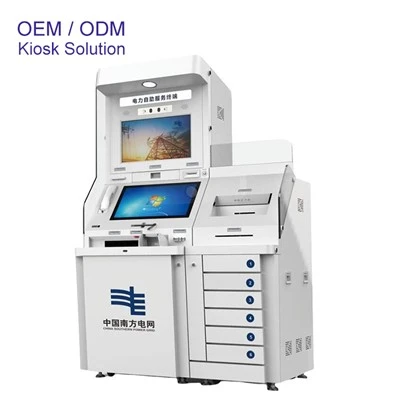
If you’ve ever stood in a laundromat at 2 a.m., staring down a broken payment machine, juggling quarters and a phone that’s at 1%, you know self-service laundry’s biggest pain point is payment. For years, most laundromats relied on single-screen kiosks or old coin boxes that break all the time, take forever to process cards, and leave users confused when something goes wrong. As a dual screen self-service kiosk supplier, I get asked this question all the time: Can a dual screen self-service kiosk actually work for laundry payments? The short answer is yes, it not only works—it solves way more problems than your average laundromat payment setup. Let me break down why, using real use cases and the kind of stuff we see when we install these for laundromats across the US.
First, let’s remember what makes dual screen kiosks different from the single touchscreens most laundromats use. A single screen makes you do everything on one display: select your washer/dryer, enter payment, confirm your cycle, all while trying to not mess up the timer. But dual screens split the work, which cuts confusion big time. Let’s think about a typical laundromat user: a college student on a Tuesday night, a mom with three screaming kids on a Saturday, or an older user who isn’t great with tech. For a student, one screen can show all the active machines in real time (no more guessing which washers are free) while the other walks them through payment step by step. No more scrolling through tiny text or mixing up buttons because everything’s crammed on one screen.


Wait, I know what some small laundromat owners are thinking: “Dual screen kiosks sound fancy, but do they handle payments the same way as my old machine?” Yeah, they do—actually, they handle payments way better, because they’re built like other payment kiosks you probably already use. Like, if you’ve ever used a self-checkout at the grocery store or a tax payment kiosk at your local government office, you’ve seen similar tech. We’ve designed our dual screen payment kiosks to work with every major payment method: credit/debit cards, mobile wallets (Apple Pay, Google Pay), even cash and coin if a laundromat still wants that option. We’ve built these to be flexible, so we can tweak the software specifically for laundry use, instead of forcing laundromats to adapt their setup to a one-size-fits-all kiosk.
Let’s talk about the biggest win for laundromat owners: reducing “no-shows” and fraud. Ever had someone pay for a $2 washer, start the cycle, then leave and use a free washer elsewhere? With a single kiosk, there’s no easy way to confirm they’re using the machine they paid for. Our dual screen setup fixes that perfectly. One screen lets the user select their exact washer or dryer (we even label them with numbers, so no mix-ups), then the second screen shows a live confirmation: “You selected Washer 4, 30-minute cycle, total $2.50. Insert card or tap mobile wallet now.” That confirmation step cuts down on people skipping out on payments because they have proof of their transaction, and laundromats can check a log of every transaction to make sure no one’s scamming the system. Plus, we’ve integrated anti-fraud measures just like those used in our dual screen touch screen payment kiosk line—so skimmers can’t easily steal card info, which is a huge fear for small businesses that can’t afford chargebacks.
Another thing: accessibility. Laundromats have a mix of users, and single screen kiosks often miss the mark for people with disabilities, or even just people who are tired and distracted. Let’s say an older user who doesn’t use mobile wallets needs to pay with a $20 bill. On a dual screen, they can pull up the machine list on one screen with big, clear buttons, and the other screen walks them through inserting cash, with large text and audio prompts (we can add that extra feature for laundromats who want it). No more squinting at tiny text or guessing where to insert a bill—split screens make the process straightforward for everyone. This is actually why a lot of local governments have started using dual screen government service kiosk for things like permit applications, because accessibility is non-negotiable, and we built our laundry kiosks with that same standard.
I’ll be real with you, though—early on, some laundromat owners were hesitant to switch. They thought dual screen kiosks would be too expensive, or too complicated to maintain. But here’s the thing: our dual screen self service kiosk line is built for high-traffic areas, so it’s way more durable than the old plastic single-screen machines that break after a year. We use scratch-resistant glass, and the software is cloud-based, so if a screen glitches, we can fix it remotely instead of sending a tech out in the middle of the night. For laundromats that stay open 24/7, that downtime is money lost—remote support is a game-changer.
We’ve actually tested this with a small laundromat in Austin, TX, that had been using single-screen kiosks for five years. They switched to our dual screen setup last year, and their owner told us their revenue went up 18% in the first three months. Why? Less payment fraud, less broken machines (so fewer people leaving because their machine isn’t working), and way more users who don’t give up mid-transaction because it’s not confusing. One of their regulars, a mom who brings her two kids every Saturday, said it used to take her 10 minutes just to figure out payment on the old machine; now it takes 2 minutes, and her kids don’t get antsy waiting around. That’s the kind of real feedback that makes us confident this works.
Wait, let’s address a common myth: some people think dual screens are just for fancy places like malls or airports, not neighborhood laundromats. No, that’s not true. We’ve customized our kiosks for all types of spaces—from 10-machine laundromats in small towns to busy 50-machine locations in downtown areas. For smaller laundromats, we can even set the kiosk to show machine availability on one screen, and a quick payment process on the other, so it doesn’t feel overwhelming. For reference, our dual screen interactive touch screen kiosk line has the same flexible software, so we can adjust size and features to fit any space, no matter how big or small.
Another win for laundromat owners: real-time data. With old coin boxes or basic single kiosks, you have to count cash every day, which takes time and can lead to errors. Our dual screen kiosks track every transaction automatically—so you can check a phone app or dashboard to see how much revenue you made that day, which machines are the most popular, even when you’re closed. That helps you adjust your pricing or cycle times—like, if the 60-minute washer is only used occasionally, you can switch it to a 30-minute option to turn it over faster. No more guessing how your business is doing; the data is right there.
I know what you’re thinking: “What if the kiosk breaks?” Like I said earlier, these are built for high-traffic, public use, so they’re way more durable than the average tablet. We offer 24/7 support, so if something does go wrong, someone will get back to you within an hour, not two days. And compared to replacing broken single-screen kiosks every 1-2 years, our dual screen kiosks can last 5+ years, which saves laundromats money long-term. We also offer flexible leasing options for small business owners who don’t want to pay a huge upfront cost, so it’s accessible for everyone, not just big chains.
Let’s circle back to the original question: Can a dual screen self-service kiosk be used for self-service laundry payment? From what we’ve seen with dozens of laundromat clients, the answer is a resounding yes. It solves the biggest pain points for both users (confusing payments, broken machines, accessibility issues) and owners (fraud, downtime, manual count work). It’s not just a fancy upgrade—it’s a tool that actually makes running a laundromat easier and more profitable.
If you’re a laundromat owner, facility manager, or anyone looking to upgrade their payment system, we’d love to chat. We’ve worked with government agencies, retail spaces, and now laundromats to build custom kiosks that fit specific needs—just like we did for the dual screen government tax payment kiosk line, which had to meet strict security standards. Our laundry kiosks are built with the same level of security and reliability, tailored to your space and budget. Don’t stick with a payment system that’s stuck in the 90s—reach out to us to learn more about how our dual screen self-service kiosks can work for your laundry business.
References:
- Small Business Administration. (2023). Enhancing Customer Experience in Neighborhood Laundromats: Key Solutions. Retrieved from sba.gov
- National Laundromat Association. (2022). 2022 Laundromat Industry Report: Revenue Drivers and Pain Points. Retrieved from laundromat.org
- Accessibility Guidelines for Public Kiosks. (2021). Americans with Disabilities Act (ADA) Standards for Accessible Design. Retrieved from ada.gov